Automatic reference audit · Hashes, commands and runtime observations · Every differing pixel · Standalone verification
Unresolved. All three NTSC modesplit tests still fail their original strict assertions. No emulator timing, reference selection, pixel mask or tolerance changed.
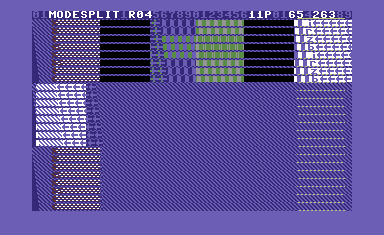
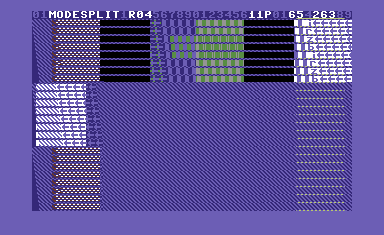
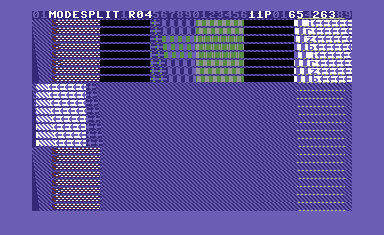
The earlier assumption that disagreement with both images pointed to one emulator defect was too broad. At every pixel where JSIDPlay2 differs from VICE, it agrees with upstream. At every pixel where it differs from upstream, it agrees with VICE. VICE 3.7.1 and 3.10 produce identical captures, each repeated twice with active SID emulation.
| Comparison | Different logical pixels | Interpretation |
|---|---|---|
| JSIDPlay2 / VICE | 192 | Text ECM transition, x=48–62, y=84–145 |
| JSIDPlay2 / upstream | 134 | 108 in the asserted combined-mode fetch region; 26 elsewhere |
| Upstream / VICE | 326 | Union of the two disjoint sets |
| Overlap between JSIDPlay2 disagreement sets | 0 | These are separate disagreements |
Images below use the same 384×235 logical viewport. No pixels are ignored. Original files, repeated captures and their hashes remain linked in the provenance.
At raster 76, internal cycle 41, the combined transition writes D011 from 5b to 3b.
The fetch reads $0441 = $5f with the live ECM sample. Pixel (162,36) is VIC 5 in JSIDPlay2 and VICE, versus VIC 6 upstream.
Holding the previous whole ECM mask would instead select $0041.
At raster 124, internal cycle 27, text enters ECM: D011 is 5b, while the previous fetch mode is zero.
JSIDPlay2 retains $1af9 = $99 for that fetch and uses $18f9 = $10 on the following cycle.
Pixel (48,84) is VIC 14 in JSIDPlay2 and upstream, versus VIC 1 in VICE.
The debugger logpoints record both fetches and rendered pixel blocks without changing machine state.
The historical 2019 videomode-v_ntsc control still matches its complete image (90,240 pixels).
Its sensitive bitmap entry uses $0a79; retaining the old whole ECM mask would select $0879.
The two programs exercise different address bits. Their software images do not establish independent A9/A10 propagation delays, so a special mask chosen to satisfy both would need physical validation.
The upstream notes identify MOS6567R8/2684 in a Rev C Breadbox and warn that crafted references may contain mistakes. The photo visibly runs MODESPLIT R01. The current binary is R04, which moved video memory to bank 2 and initialized the entire bank. Its header and memory patterns differ from the photographed program. No hash binds that physical capture to the current binary.
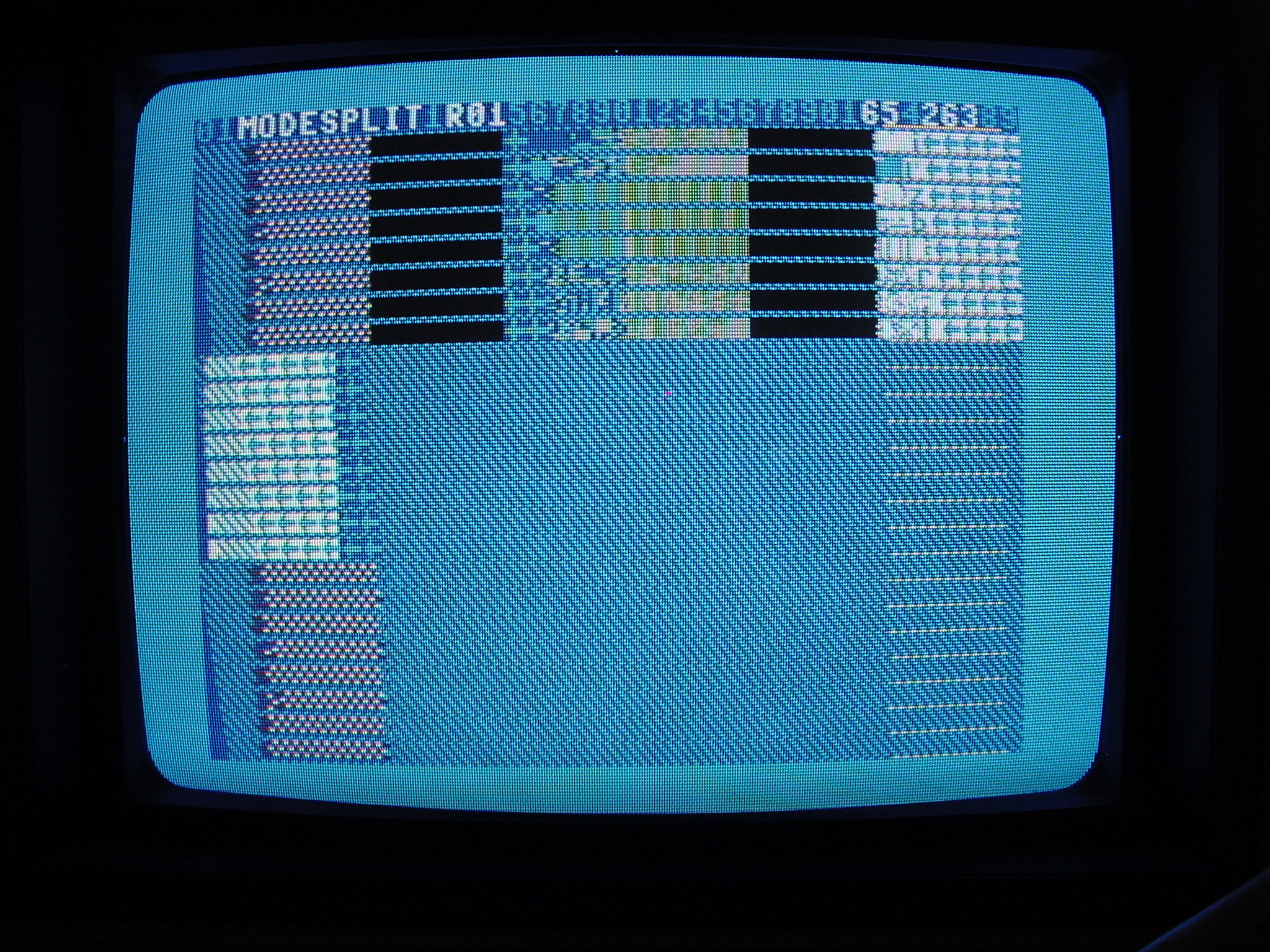
The upstream testbench TODO also flags NTSC modesplit screenshots for checking and questions videomode references. A new capture of the exact R04 binary on identified hardware, with separate A9/A10-sensitive transitions, would resolve more than another software reference change.
117 focused cases: 112 PASS, four existing FAIL, one existing unsupported-NTSC SKIP, zero errors. The failures are the VICE-based NTSC modesplit contract, two upstream-region modesplit contracts, and the separate historical videomode2 eight-pixel discrepancy. PAL whole-frame checks, D011 and MCM region checks, all 88 graphics-fetch controls and the historical videomode-v control pass. The saved complete suite remains 7,727 tests, 129 failures, 181 skipped and zero errors; it was not rerun.