Automatic reference audit · Exact inputs, raw counts, source hashes and debugger observations · Standalone recalculation
Both original guest tests remain FAIL. The added C64 case exposes the same existing range failure; it is additional coverage, not an emulator-core change.
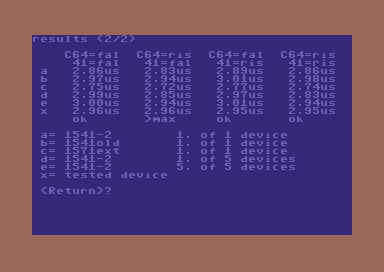
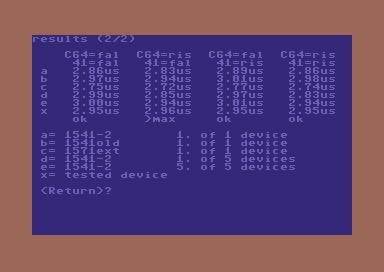
The unchanged NLQ program measures a relative round trip between C64 and drive. Both PAL machine presets use a stock 1541-II, a 985248.4 Hz host and a 1000000 Hz drive, with 10000 trials per delay. The failing column is C64 rising / drive falling: both display 2.96 µs against the original maximum of 2.94 µs. No guest range, tolerance or verdict was changed.
| Machine / CIA | C64 falling Drive falling | C64 rising Drive falling | C64 falling Drive rising | C64 rising Drive rising |
|---|---|---|---|---|
| C64 / MOS6526 | 2.955325 | 2.955625 | 2.953825 | 2.954825 |
| C64C / MOS6526A | 2.954425 | 2.955425 | 2.954425 | 2.954825 |
Values are microseconds recalculated from the complete guest count arrays with the original BASIC formula. Display rounding and the original four range checks are reproduced by the linked script. The retained snapshots contain the complete scalar table and R(1,1,11) array; later arrays are excluded. These observations are software measurements, not physical recordings.
All 59 digital wiring, polling-loop and clock-domain controls pass. An independent perfect6502 rerun confirms all 44 instruction-spacing cases using the retained transistor netlist. The observed digital-loop example records host request/sample/restore at clocks 33/39/58 for delay 2, drive polls at 31/38, and acknowledgement at 44. This confirms the six-clock host sample, 25-clock request pulse, seven-clock polling cadence and six-clock response after an accepting read.
The existing bridge advances the drive through one further host clock before publishing a host write, and through the current host clock before a read. With T=1000000/985248.4 µs, its digital phase calculation gives 6−3T≈2.955083 µs, close to both observed results. That calculation does not establish the correct physical phase, analog input thresholds or edge-dependent inverter, pull-up and cable delays. The few-count difference between CIA presets does not explain the shared range failure.
Resolving physical timing needs a simultaneous capture of host/drive PHI2, host PA4/CLK, drive PB2/PB1/DATA and host PA7, with board/chip revisions, bus topology, temperature and acquisition resolution recorded. The author’s retained README describes a relative comparison with 0.01 µs measurement error and cold/warm variation. The original strict limits remain asserted.
Independent instruction-check inputs and outcomes · Complete transistor trace · C64 BASIC snapshot · C64C BASIC snapshot